Chimichurri: What Separates the Argentine From the Uruguayan
Two national versions of one finish, and the differences are specific rather than vague. What goes in each, what never does, and how to tell a good jarred one from a bad one.
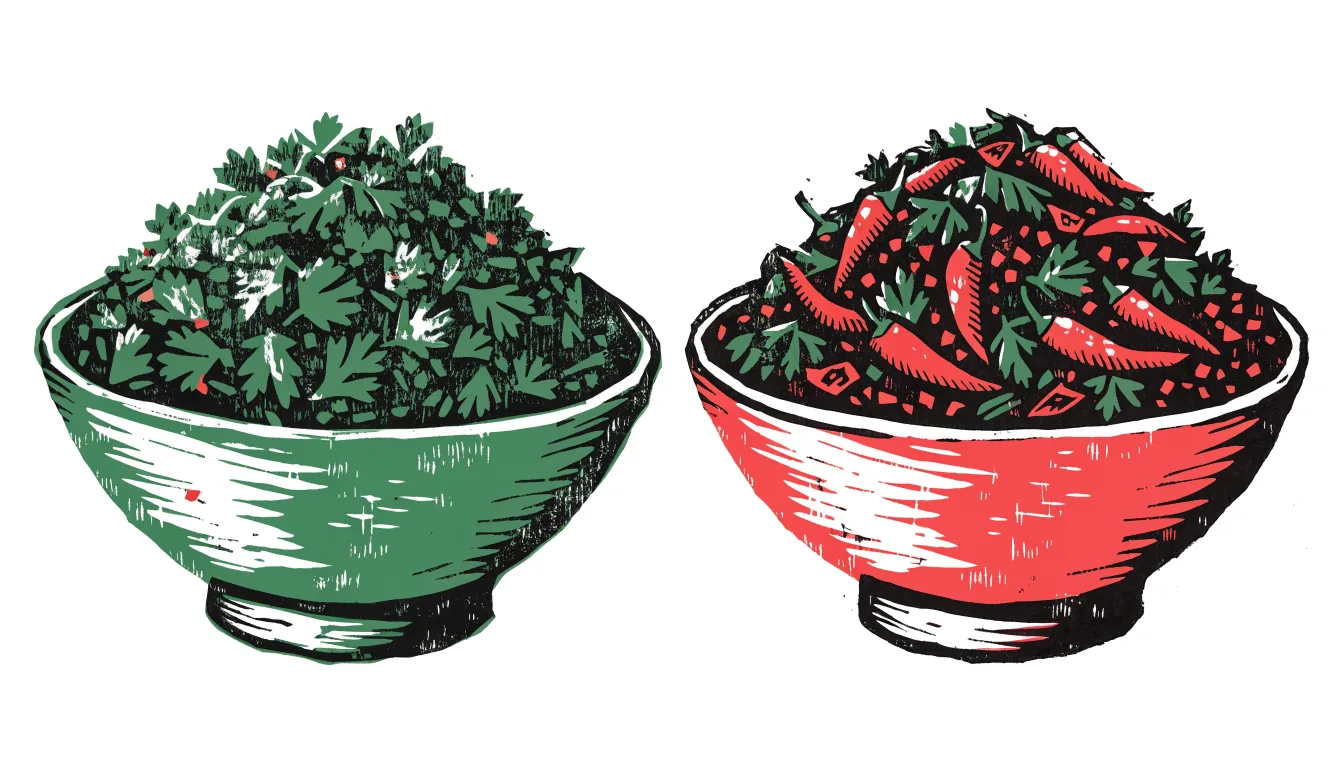
Chimichurri is a raw herb and vinegar finish, added to grilled meat at the table rather than cooked into it, and the Argentine and Uruguayan versions differ mainly in how much they lean on oregano and dried aromatics against fresh parsley and garlic. Both are the same preparation doing the same job.
It is the best known preparation on this site and also the most mangled, so this page is mostly about what chimichurri is not: not a marinade, not a green sauce, not a blend of whatever herbs are in the drawer.
What chimichurri actually is
Chimichurri is chopped parsley, garlic, dried oregano, vinegar, oil and salt, with chilli flake in most versions, left raw and spooned onto meat as it is eaten. Nothing is cooked and nothing is blended smooth.
The texture is part of the definition. A proper chimichurri is loose and separated, with the herbs suspended in the oil and vinegar rather than emulsified into them. If it pours like a dressing or holds together like a pesto, something has gone wrong in the method.
It belongs to the finish family: raw or barely cooked, added at the table, and separable from the dish. That is what distinguishes it from a base, which is cooked in at the start and cannot be taken back out.
What it is not
It is not a marinade, though it is often sold as one. Raw garlic and vinegar sitting on meat for hours changes the surface texture and does not do what the finish does, which is to cut through fat at the moment of eating.
It is also not a blended green sauce. A food processor emulsifies the oil and bruises the parsley, and the result is a different preparation that happens to share ingredients.
Argentine against Uruguayan
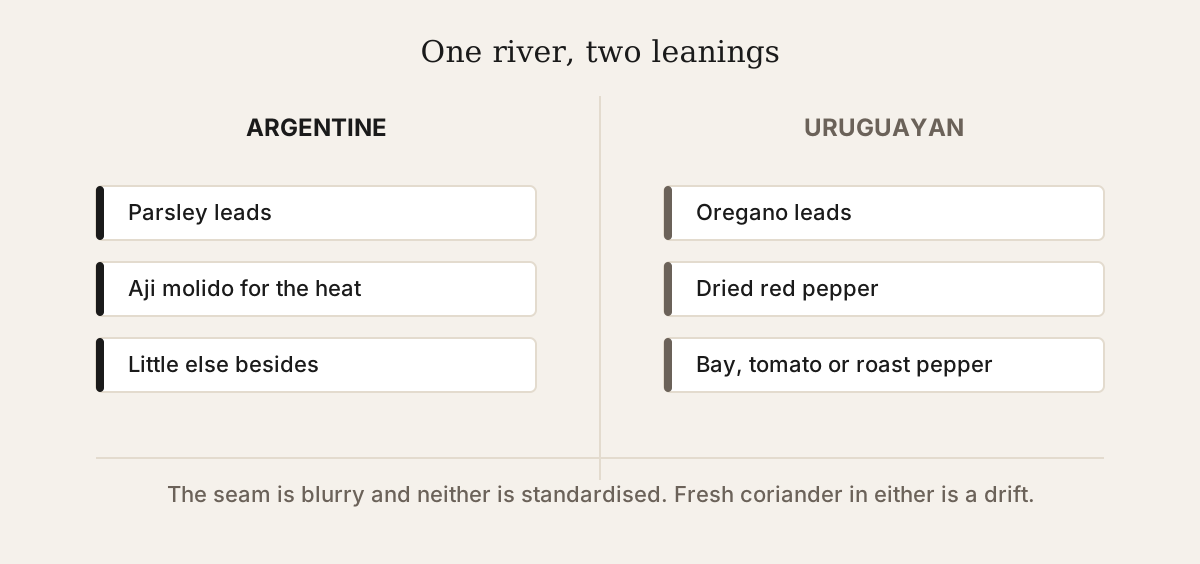
The Argentine version is the greener and fresher of the two, and the Uruguayan leans harder on dried oregano and often on a little more vinegar, which makes it sharper and darker. That is the honest summary, and the overlap between them is larger than the difference.
Argentine chimichurri typically runs parsley-forward, with garlic, dried oregano, red wine vinegar, oil and ají molido, which is a coarse dried chilli flake. Some cooks add a little water to loosen it.
Uruguayan chimichurri commonly carries more dried oregano relative to parsley, and it is not unusual to find dried red pepper, bay or a little tomato and roasted pepper in the mix. It reads as more savoury and less bright.
The seam is genuinely blurry. Households on both sides of the river make versions that would pass in the other country, and neither recipe is standardised. Anyone who tells you there is one correct chimichurri is describing their family rather than a national rule.
The one thing both refuse
Neither version uses fresh coriander, and its presence is the clearest sign a recipe has drifted. Coriander in a chimichurri points to a cook reaching for a different flavour tradition, and while the result may be pleasant it is no longer the preparation. Parsley is doing a specific job here: it is grassy and neutral enough to carry the vinegar and garlic without competing.
How to judge a jarred one
Read the first three ingredients. A good jarred chimichurri lists a herb, an oil and a vinegar near the top, and a poor one lists water, oil and a thickener.
The tells, in order of reliability.
Water high in the list means the product has been extended, and it is the most common shortcut. Xanthan gum or another thickener means the oil and vinegar have been forced to stay combined, which the fresh preparation never does. A long preservative list is a different product from a preparation that is preserved by its own vinegar and salt.
Colour is a weaker signal than it looks. A dull olive green is normal for a jar that has been on a shelf, because parsley darkens in acid. A vivid emerald jar is more likely to contain colouring than to be fresher.
Checked on 13 August 2026, the first page of United States results for chimichurri was dominated by recipe publishers rather than by sellers, which is a statement about that search on that date. The practical consequence is that finding a jarred product to buy takes a more specific search than the ingredient name alone.
Making it, and the two mistakes
Chop by hand, combine, and let it sit for at least half an hour before serving, because the vinegar needs time to pull the garlic and oregano into the oil. The method is almost nothing; the mistakes are where the quality goes.
The first mistake is the machine. A processor turns parsley to paste and forces an emulsion. Hand chopping keeps the leaf structure, which is what gives the finished sauce its loose texture.
The second is serving it immediately. Straight after mixing, chimichurri tastes of raw garlic and sharp vinegar as separate things. After half an hour it tastes of one thing. After a day in the refrigerator it is better again, though the parsley will have darkened.
On ratios, since almost no source states one. A workable starting point is roughly one part red wine vinegar to three parts oil, with enough flat-leaf parsley to make the mixture crowded rather than soupy, then garlic, dried oregano, chilli flake and salt to taste. Chimichurri is not a set recipe and households vary the vinegar sharply, so treat that as a place to begin and adjust on the second batch rather than as a formula. The one ratio worth holding is the vinegar to oil, because too little acid makes it greasy and too much makes it a dressing.
What to put it on
Grilled beef is the default and the reason it exists, and it works on anything where fat needs cutting. Its job is acid and freshness against richness.
Beyond steak it belongs on grilled chicken, roasted potatoes, grilled or roasted vegetables, and eggs. It also works stirred into beans. Where it works less well is on delicate fish, because the vinegar and raw garlic overwhelm rather than balance.
Chimichurri rojo and chimichurri verde
The red and green versions are not two recipes so much as one recipe with the dried pepper turned up or down, and the red is more common in Uruguay and in the Argentine north.
Chimichurri verde is the version described above: parsley-forward, with the colour coming from fresh herb. Chimichurri rojo raises the proportion of dried red pepper, often ají molido or a mild paprika-type pod, sometimes with a little tomato or roasted red pepper, and the result is darker, rounder and slightly sweeter.
Neither is a corruption of the other. What matters is that the red version leans further into the dried-aromatic character that already distinguishes Uruguayan chimichurri, so a very red chimichurri and a very oregano-heavy one tend to be the same style seen from two angles.
A practical consequence when buying. A jar labelled simply chimichurri in the United States is more often the green style, and a red one usually announces itself. If you want the darker, sweeter version, look for it by name rather than assuming a brand will specify.
The dried mix, and when it makes sense
Dried chimichurri mixes are a real product rather than a shortcut invented for export, and they make sense in exactly one situation: when you want the dried components measured and are supplying the fresh ones yourself.
A dried mix contains the oregano, the chilli flake, the garlic in dried form, and the salt. It cannot contain the parsley in any useful state, for the reason given in the FAQ below, and it cannot contain the oil or vinegar.
So a dried mix is a base to build on, not a finished preparation. Used as intended, you add fresh parsley, fresh garlic if you want it sharper, oil and vinegar, and you have skipped the measuring rather than the making. Used as sold on some packets, rehydrated in oil and vinegar alone, it produces something flat that tastes mostly of dried oregano.
Judge a dried mix on its chilli and its salt. The salt proportion is often high because salt is cheap and bulks the packet, and a mix that lists salt first is mostly seasoning. A mix that names its chilli, ají molido rather than generic red pepper, is usually from a producer paying attention.
This is the one place where the dry blend family and the finish family touch, and it is worth being clear about which you are buying.
Storage
Refrigerated in a sealed jar, chimichurri keeps for one to two weeks, and the herbs darken well before it becomes unsafe. Cover the surface with a thin layer of oil to slow that down.
It does not freeze usefully. Freezing collapses the parsley structure and the result thaws as a dull, watery version of itself. Since it takes ten minutes to make, freezing solves a problem that does not exist.
The dried version, and when it is the right choice
Chimichurri seco is a dry mix of the same herbs and spices, sold in packets and rehydrated with oil and vinegar at home, and it is standard rather than a compromise.
It is what most Argentine households keep. A packet of dried mix costs little, keeps indefinitely and is made up in minutes when a grill is lit.
Rehydrate it in the vinegar first, then add the oil. Dried oregano and parsley need water to open, and adding oil first coats them and keeps them closed.
Give it half an hour. A dry mix made up and used immediately tastes dusty; the same mix rested tastes like chimichurri.
It is the better option out of season. Poor winter parsley makes a worse fresh chimichurri than a good dry mix properly rehydrated does.
Frequently asked questions
Is chimichurri spicy?
Mildly, in most versions, and often not at all. The chilli component is usually ají molido, a coarse dried flake that contributes warmth and colour rather than sharp heat. Heat varies widely by household and by brand, so a jar that specifies its chilli is more predictable than one that does not.
Can I use dried parsley?
No, and this is the one substitution that does not work at all. Dried parsley has lost the grassy freshness that the preparation is built around, and it turns the sauce into oil, vinegar and dust. Dried oregano is correct and traditional; dried parsley is not a substitute for fresh.
What is the difference between chimichurri and salsa verde?
They occupy the same position at the table and are built differently. Chimichurri is parsley, garlic, dried oregano and vinegar, left loose and raw. Italian salsa verde typically carries anchovy, capers and bread or egg yolk, and is often blended smoother. The two are relatives rather than versions of one thing.
How long should chimichurri sit before serving?
At least thirty minutes, and it improves for several hours. The wait lets the vinegar draw flavour out of the garlic and oregano and lets the oil take it up. Serving it straight after mixing is the most common reason a homemade chimichurri tastes harsh.
Does chimichurri need to be refrigerated?
Once made, yes, though it will sit safely on a table through a meal. Its vinegar and salt content slow spoilage but do not make it shelf-stable in the way a cooked and sealed preparation would be. A jarred commercial product is different and should follow its own label.
The pairing
“Balderrama”, Mercedes Sosa, 1972, Argentina.
Regional. A zamba about a specific place at a specific hour, from the north of the country where the grilling tradition chimichurri belongs to is at its least self-conscious.
We write about South and Central American seasoning preparations, what separates the regional variants, and where to buy them in the United States.