Llajua: The Bolivian Table Sauce Made Fresh Every Day
Tomato, locoto and quilquiña, ground rather than blended. What goes in it, what never does, and why it is not a salsa.
Llajua is the Bolivian table sauce of tomato, locoto and quilquiña, ground on a stone rather than blended and made fresh in small quantities. It sits on the table at almost every Bolivian meal and it is expected to be made the same day.
It is the most consistently overlooked preparation in the finish family in English-language writing, and the one whose defining herb is hardest to source outside Bolivia.
What llajua actually is
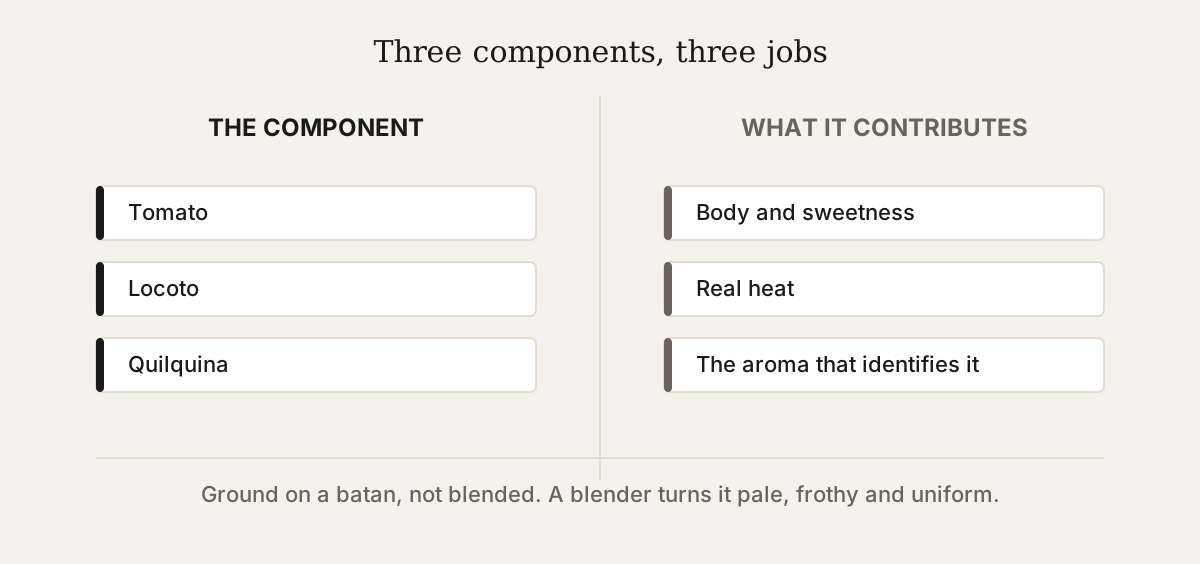
Llajua is ripe tomato and locoto ground together with quilquiña and salt into a loose, textured sauce, served at the table and added by the eater. Three components and no cooking.
Quilquiña is the identifying herb and the reason a llajua made without it is something else. It is pungent, slightly soapy to some palates, and unlike anything in the Mediterranean herb repertoire.
Locoto is the Bolivian name for rocoto, the thick-walled Andean pod with black seeds. It brings real heat, and llajua is genuinely hot in most households.
Tomato provides body and sweetness and is the largest component by volume.
Nothing else is required. Onion, garlic, lime and coriander all appear in some versions and none of them is standard.
The grinding, and why it matters
Llajua is traditionally ground on a batán, a flat stone with a rocking hand stone, and the texture that produces is part of the definition.
Grinding tears and crushes rather than cutting, so the tomato breaks down into a loose pulp while pieces of pod and herb remain distinct. The result is textured rather than smooth, and it sits on food rather than running off it.
A blender produces a different sauce. It emulsifies and aerates, turning llajua pale, frothy and uniform. It is still edible and it is not the preparation.
A mortar is the practical substitute for anyone without a batán, worked in batches.
This is the same principle as the pesto mortar argument: where a traditional tool changes the texture measurably, the tool is part of what the thing is.
Quilquiña, and what to do without it
Quilquiña is Porophyllum ruderale, the same plant known as papalo in Mexican usage, and it is very difficult to buy fresh in the United States.
The Mexican name is the useful route. Papalo turns up in Mexican produce markets in some American cities, seasonally and unpredictably, and it is the same herb. Anyone searching for quilquiña and finding nothing should search for papalo.
Seed is available and the plant grows readily in warm conditions, which for a herb this hard to buy is a more realistic option than it sounds.
There is no good dried substitute. Quilquiña’s character is volatile and drying removes most of it.
Coriander is the usual fallback and it is not close. It is the right register of freshness and the wrong flavour entirely, and a llajua made with coriander is closer to a Chilean pebre in effect. That is a legitimate thing to eat and it is not llajua.
How it differs from the other finishes
Llajua sits closest to pebre and is built on a different herb and a much hotter pod.
Against Chilean pebre, which is coriander, onion and ají in oil and vinegar, llajua carries no onion and no acid beyond the tomato, and its heat is far higher.
Against ají picado and ají criollo, llajua is tomato-led where those are onion-led.
Against a Mexican salsa, the resemblance is closest in appearance and misleading in composition. Llajua carries no lime, no coriander in its standard form and no cooked or charred element, and its herb belongs to a different tradition even where the plant is the same species.
Its position is identical to all of them. Raw, added at the table, separable from the dish.
Buying it, and why you will not
Llajua is a made preparation rather than a bought one, and commercial versions are rare in the United States.
Checked on 13 August 2026, the first page of United States results for llajua returned reference material and Bolivian recipe sites with no recipe-publisher drift and no sellers, which describes that search on that date rather than recommending any seller. Counting rule: a result counts as recipe drift when the domain is a general recipe publisher rather than a regional or reference source. On that rule the drift was zero, the cleanest of any finish head on this property.
The practical consequence is that llajua has to be made, and that the only real sourcing problem is the herb.
Locoto is easier to find than quilquiña, as frozen pods or paste in Latin American grocers, or as fresh manzano in Mexican produce markets.
Storage
Refrigerated, one to two days, and it is expected to be made fresh rather than kept.
Llajua deteriorates quickly because it is raw tomato and fresh herb with no acid or oil to protect it. The tomato weeps, the herb darkens, and by the second day the texture has gone.
It does not freeze. Raw tomato collapses entirely and the herb turns to sludge.
Make small quantities. In Bolivia it is made daily, and that is a practical response to the preparation rather than a ceremony.
Frequently asked questions
What is quilquiña and can I substitute it?
Quilquiña is Porophyllum ruderale, the same plant sold as papalo in Mexican markets, and it is pungent and unlike any Mediterranean herb. There is no close substitute. Coriander is the usual fallback and produces a different sauce closer to a Chilean pebre. Searching for papalo rather than quilquiña is the most practical route to finding it in the United States.
Is llajua very spicy?
Usually yes. It is built on locoto, the thick-walled Andean pod also called rocoto, which is considerably hotter than the ajies used in most other finishes on this site. Household heat varies and deseeding the pod lowers it substantially, but a standard llajua is hot by the standards of the wider finish family.
Can I make llajua in a blender?
You can, and it produces a paler, frothier and smoother sauce that is not really llajua. Grinding on a stone or in a mortar tears the components rather than cutting them, leaving the tomato as loose pulp with pieces of pod and herb still distinct. The texture is part of the definition rather than a stylistic preference.
Is llajua the same as a Mexican salsa?
They occupy the same position at the table and are composed differently. Llajua carries no lime, no coriander in its standard form, and no charred or cooked element, and it is built on quilquiña and locoto. The resemblance is in appearance rather than in ingredients, which is a recurring pattern across the finish family.
How long does llajua keep?
One to two days refrigerated, and it is meant to be made fresh. Raw tomato and fresh herb with no oil or added acid deteriorate quickly, so the tomato weeps and the herb darkens by the second day. Freezing destroys it entirely. Bolivian households make it daily, which is a practical response rather than a tradition for its own sake.
The pairing
“Llorando se fue”, Los Kjarkas, 1981, Bolivia.
Regional. A Bolivian saya that travelled the world in a form its authors did not choose, which pairs with a sauce that is everywhere in Bolivia and almost unknown outside it under its own name.
We write about seasoning preparations across Latin America, what separates the regional variants, and where to buy them in the United States.