Muña: The Andean Mint That Is Actually a Mint
The high-altitude Peruvian and Bolivian herb used in teas, stews and potato dishes. What it is, how it differs from huacatay, and why the altitude claim follows it everywhere.
Muña is a high-altitude Andean herb of the genus Minthostachys, genuinely in the mint family, used in teas, stews and potato dishes across the Peruvian and Bolivian highlands.
It is the one Andean herb on this site where the mint comparison is botanically accurate rather than a marketing gloss.
What muña actually is
Muña is a shrubby perennial in the genus Minthostachys, in the mint family Lamiaceae, growing at high altitude in the Peruvian and Bolivian Andes.
Several species carry the name. Minthostachys mollis and Minthostachys setosa are the two most often meant, and a package labelled muña rarely specifies which.
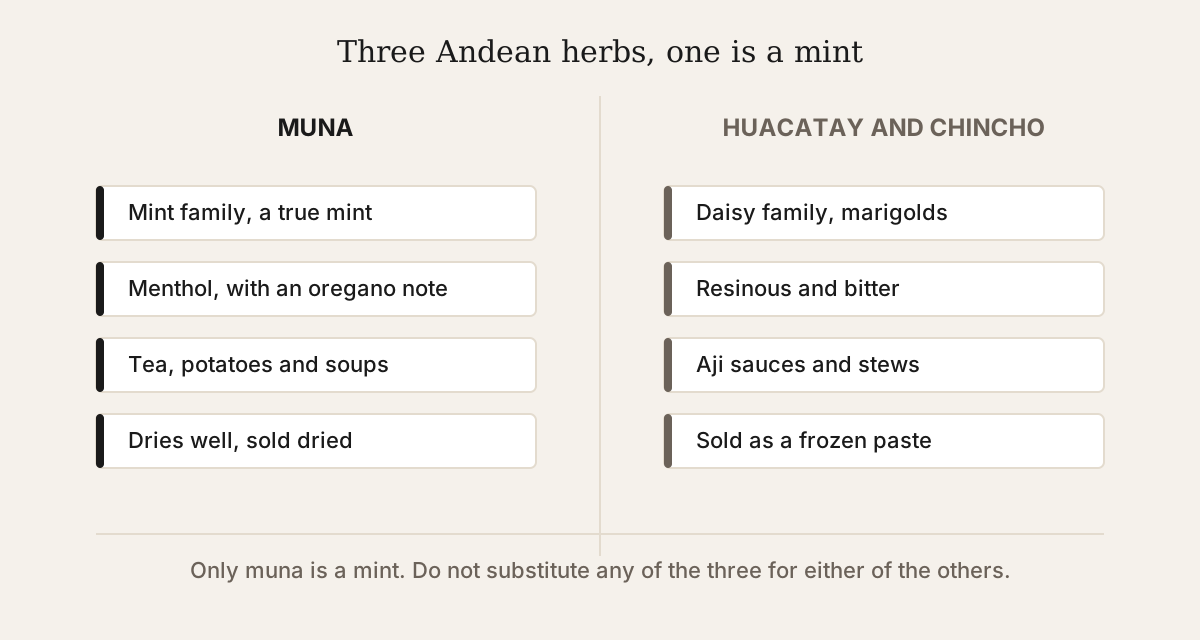
It is a true mint relative, unlike huacatay and chincho, which are marigolds in the daisy family despite the black mint name attached to huacatay in English.
It grows between roughly 2,700 and 3,400 metres, which is why it is associated with the high Andes and why it is not a lowland herb.
The leaves are small and the plant is woody, closer in habit to thyme than to the soft-stemmed garden mints.
What it tastes of
Muña is mint-adjacent with a strong oregano and menthol character, and it is more medicinal than any European mint.
The menthol is obvious and is the first thing anyone recognises.
Underneath it there is an oregano-like note that keeps it from reading as a sweet mint, and this is what makes it work in savoury food.
It is more astringent than spearmint or peppermint and does not carry the sweetness that makes those herbs read as dessert flavours to an English-speaking palate.
Dried muña is noticeably flatter than fresh but survives drying much better than chincho does, which is why the dried leaf is what reaches export markets.
Where it belongs
Muña belongs in Andean highland cooking: in infusions, in potato dishes, in soups and stews, and traditionally as a preservative packed with stored tubers.
Muña tea is the single most common use and is drunk widely in Peru and Bolivia, frequently offered for altitude discomfort and digestion.
Potato dishes take it as a seasoning, which follows from both plant and tuber being highland crops.
Soups and stews use it as a background herb rather than a finishing one.
Stored potatoes were traditionally packed with muña, which is a preservation practice rather than a seasoning one and is the origin of much of the plant’s reputation.
It is used dried more often than fresh outside the growing regions, unlike huacatay, which is usually sold as a frozen paste.
The altitude claim, stated carefully
Muña is widely sold and served as a remedy for altitude sickness, and that is a traditional and commercial claim rather than something this page can verify.
The claim is genuinely traditional, made throughout the Peruvian and Bolivian highlands and repeated by sellers, guides and hotels.
This site does not evaluate medical claims and makes none of its own about muña. What is reportable is that the association is universal in the region and drives much of the export demand.
Where a package makes a health claim, that is the packer’s claim and not a property of the herb established here.
Buying it in the United States
Dried muña leaf and muña tea are available from Peruvian and Bolivian importers online, and the fresh herb effectively is not.
Checked on 13 August 2026, a United States search for the term returned importer and tea listings alongside botanical and travel references on the first page. Counting rule: a result counts as a seller when it offers muña leaf or muña tea for purchase. Sellers were present on that rule, which describes that search on that date and is not a recommendation of any seller.
Most of what sells is tea, in bags or as loose dried leaf, rather than a culinary seasoning package.
Species is almost never stated on retail packaging, so a buyer is trusting the supply chain on identity.
It is not stocked in mainstream American supermarkets and is uncommon even in general Latin grocers outside Andean-focused shops.
Making the tea
Muña tea is made by steeping the dried leaf in water just off the boil for five to ten minutes.
Roughly a teaspoon of dried leaf per cup is the usual strength, and it takes a longer steep than a delicate tea without turning bitter.
Do not boil it hard. Water off the boil preserves the menthol, and a rolling boil drives it off.
It is drunk plain far more often than sweetened in the highlands, though honey is common enough.
A longer steep makes it more medicinal and more astringent, which some drinkers want and others do not, so it is worth starting short.
Substituting, honestly
There is no exact substitute for muña, and the closest approximation is a small amount of dried mint with a little dried oregano.
Dried spearmint plus dried oregano in roughly equal parts gets at both halves of muña’s character and lacks its menthol intensity.
Peppermint alone is too sweet and pushes a savoury dish in the wrong direction.
Do not substitute huacatay or chincho. They are marigolds and taste nothing like muña, despite all three being Andean herbs that English-language writing tends to file together.
For tea specifically there is no substitute worth making, since the whole point is the specific herb.
Storage
Dried muña keeps six to twelve months in an airtight container away from light.
It fades rather than spoils, and a leaf that has lost its menthol smell has lost what it was bought for.
Keep it whole rather than crushed and break it up as you use it.
Fresh muña, if you have it, behaves like a woody herb and can be dried successfully at room temperature, unlike the soft Andean herbs.
Frequently asked questions
Is muña the same as huacatay?
No, muña and huacatay are not even in the same botanical family. Muña is in the mint family, Lamiaceae. Huacatay is Tagetes minuta, a marigold in the daisy family. Muña reads as menthol and oregano, huacatay as pungent and resinous. English-language writing groups them because both are Andean herbs with strong aromas, which is not a botanical relationship.
Does muña actually help with altitude sickness?
That is a traditional and widely repeated claim throughout the Peruvian and Bolivian highlands, and this site does not evaluate medical claims. What can be said is that the association is universal in the region and is a large part of why the herb is exported at all.
Can I use muña in place of mint in a recipe?
Not in sweet applications. Muña carries an oregano-like astringency that works against desserts and sweet drinks where spearmint or peppermint belong. In savoury Andean dishes it is the correct herb and ordinary mint is the compromise, not the other way round.
Is dried muña as good as fresh?
For tea it is the standard form and entirely usual. For cooking it is flatter but still recognisably muña, which is more than can be said for chincho, whose character largely does not survive drying. Since fresh muña is essentially unavailable outside the growing regions, dried is the practical choice regardless.
Which species am I buying?
Retail packaging almost never says. Minthostachys mollis and Minthostachys setosa are the two most commonly meant, and both are sold simply as muña. A buyer outside the region is relying on the supply chain rather than on the label.
The pairing
“Llorando se fue”, Los Kjarkas, 1981, Bolivia.
Regional. A saya written by a Bolivian highland group from Cochabamba, the country and altitude where muña grows and is drunk daily.
We write about seasoning preparations across Latin America, what separates the regional variants, and where to buy them in the United States.