Pasilla Chile: The Dried Chilaca, and the Name That Causes Trouble
Herbaceous, cocoa-like and moderately bitter. What pasilla actually is, why California grocers call something else by the same name, and where it belongs.
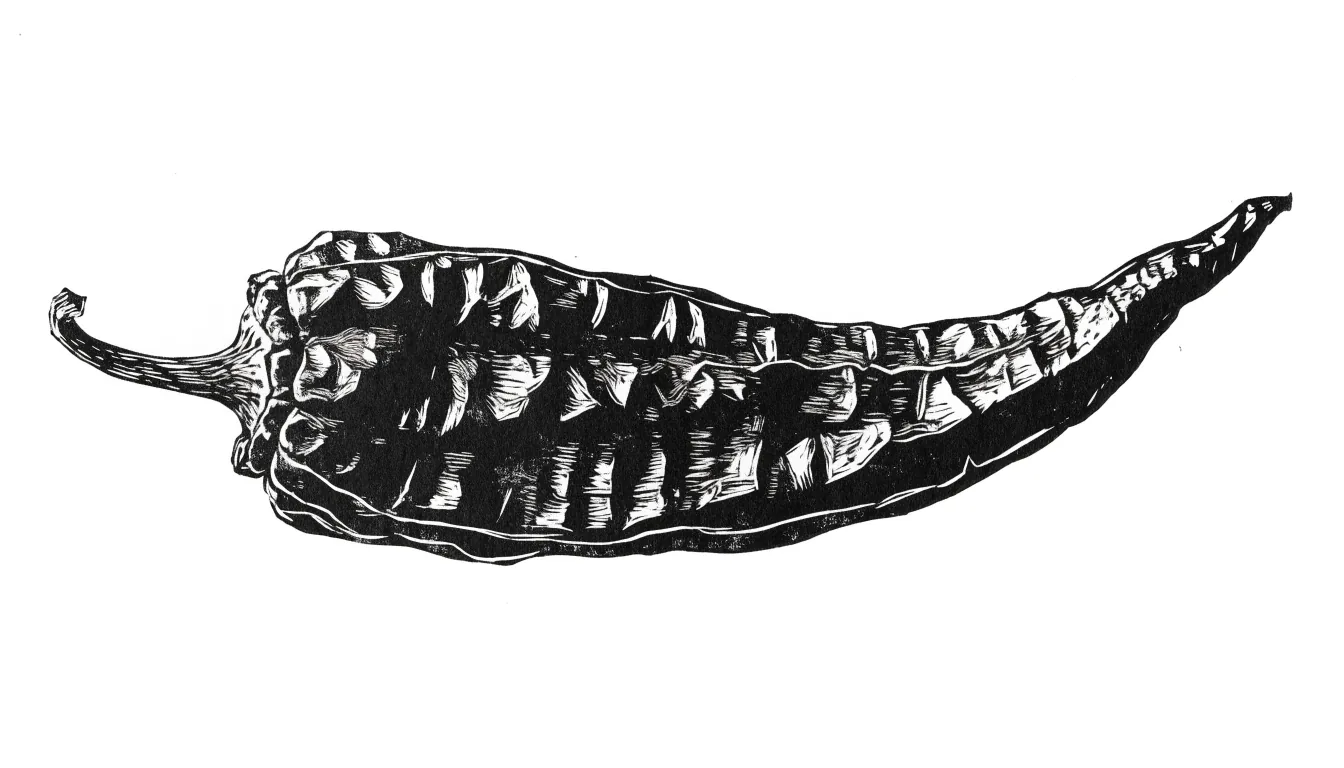
Pasilla is the dried chilaca chile, long and narrow, wrinkled and blackish brown, with a herbaceous, cocoa-like flavour and moderate bitterness.
It is not a dried poblano, though a great deal of United States retail labels ancho as pasilla and the reverse.
Coverage of Mexican ingredients on this site is researched rather than first-hand, written from published sources and supplier documentation.
What pasilla is
Pasilla is the dried form of the chilaca, a long thin dark green chile that ripens to brown.
Pasilla means little raisin, describing the wrinkled dried skin rather than the flavour.
The shape is the identifier. A true pasilla is long and narrow, roughly 15 to 20 centimetres, and never broad and flat like an ancho.
It dries to a blackish brown with a matte, deeply wrinkled surface.
It is also called chile negro, which adds a further name to an already crowded field.
What it tastes of
Pasilla is herbaceous and cocoa-like, with more bitterness than ancho or mulato and a raisin sweetness underneath.
The herbaceous note is what distinguishes it, closer to dried grass or tea than to fruit.
Cocoa and prune sit behind that.
Bitterness is a feature and is what pasilla contributes to a mole, balancing the sweeter chiles.
Heat is mild to moderate, roughly 1,000 to 4,000 Scoville units, generally a little hotter than ancho.
The naming problem
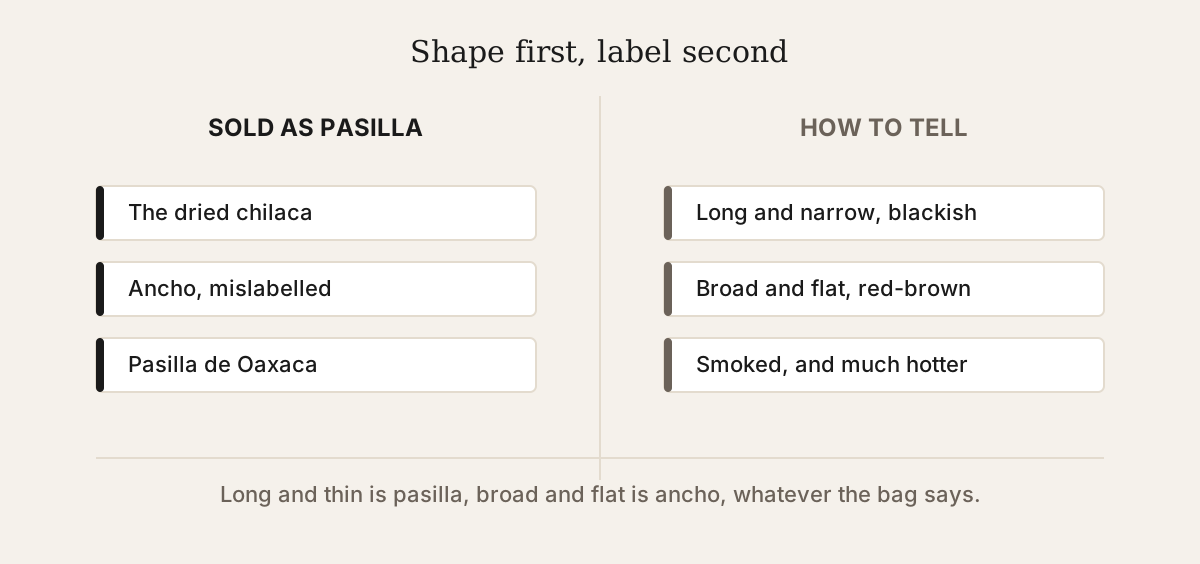
At least three different chiles are sold as pasilla in the United States, and only one of them is the dried chilaca.
The true pasilla is the dried chilaca, long and narrow.
Ancho is frequently labelled pasilla in California and in some national retail, a mislabelling old enough to have become semi-conventional. If a bag labelled pasilla contains broad flat chiles, it is ancho.
Pasilla de Oaxaca is a different chile entirely, smoked and considerably hotter, and is not a substitute for either.
The shape test resolves the first two. Long and thin is pasilla, broad and flat is ancho, regardless of the label.
Where it belongs
Pasilla belongs in moles, in adobos, in table salsas and in the sauce for dishes like chiles en nogada.
Mole poblano uses it alongside ancho and mulato.
Table salsas use it toasted and blended, where the bitterness reads as depth.
Broths and soups take a rehydrated pasilla for background.
It is often used toasted and crumbled as a garnish over soups, particularly tortilla soup, where it is used dry rather than rehydrated.
Buying it
Look for long thin pods, pliable and deeply wrinkled, and ignore the label if the shape disagrees.
Shape first, label second.
Pliable rather than brittle.
Checked on 13 August 2026, a United States search for the term returned spice retailers and recipe publishers on the first page, with some product listings showing broad flat chiles under the pasilla name. Counting rule: a result counts as a seller when it offers chiles labelled pasilla for purchase. Sellers were present on that rule, which describes that search on that date and is not a recommendation of any seller.
Using it
Toast for seconds, rehydrate, blend and strain, and taste the soaking water before using it.
Toast lightly. Pasilla’s existing bitterness makes it less forgiving of over-toasting than ancho.
Rehydrate twenty minutes.
The soaking liquid is frequently bitter and is more often discarded than kept.
Remove seeds and veins to moderate both heat and bitterness.
Storage
Airtight and dark, six to twelve months.
They lose aroma before they lose colour.
Freezing works and is worth it for bulk purchases.
Keep them whole and break them up as needed.
Frequently asked questions
Is pasilla the same as ancho?
No. Pasilla is the dried chilaca, long and narrow. Ancho is the dried ripe poblano, broad and flat. They taste different, with pasilla more herbaceous and bitter and ancho sweeter and fruitier. A great deal of United States retail labels one as the other, so the shape of the pod is more reliable than the bag.
What is pasilla de Oaxaca?
A different chile altogether, smoked and considerably hotter than ordinary pasilla, used in Oaxacan cooking. It shares part of a name and very little else, and substituting it for pasilla will make a dish smoky and much hotter than intended.
Is pasilla hot?
Mild to moderate, roughly 1,000 to 4,000 Scoville units, so typically a little hotter than ancho but not a hot chile by most standards. Its contribution is bitterness and herbaceous depth rather than heat.
Why do stores label ancho as pasilla?
The mislabelling appears to have entered United States retail decades ago, particularly in California, and it propagated through the supply chain until it became semi-conventional in some regions. It is not usually deliberate. Checking the shape resolves it in a second.
Can I substitute ancho for pasilla?
You can, and the result will be sweeter and less complex. In a mole that specifies all three of ancho, mulato and pasilla, the loss is noticeable. For a single-chile salsa the substitution changes the character substantially, since bitterness is much of what pasilla is for.
The pairing
“El Son de la Negra”, traditional, arranged Blas Galindo, 1940, Mexico.
Regional. The best-known mariachi son, from Jalisco, one of the states where the chilaca is grown and dried.
We write about seasoning preparations across Latin America, what separates the regional variants, and where to buy them in the United States.